
Can you rodent-proof a house yourself?
What DIY gets right and where it fails
Roofline and soffit elevation is where most self-performed exclusion work ends, and rodents do not.
DIY rodent proofing gets closer to the right answer than most people think
Steel wool, expanding foam, and door sweeps are the right category of solution, just not always the right materials in the right places.
Most homeowners who attempt DIY rodent proofing in Los Angeles are thinking correctly. They have identified that sealing gaps is the actual fix, not just traps, not just bait. That instinct is sound. Physical exclusion is the right answer.
The gap between a good instinct and a complete job has almost nothing to do with effort. It has to do with material failure modes and access elevation. A homeowner working from the ground with hardware store supplies is addressing the right problem, and covering roughly two-thirds of it.
This page explains what self-performed sealing genuinely accomplishes, where the materials give out, and where Los Angeles's specific rodent species creates an access problem that no amount of foam can address from ground level.
Why LA's roof rat entry zones change the DIY calculation
In Los Angeles, the dominant rodent enters from above, and that single fact changes everything about self-performed exclusion.
Rattus rattus climbs
The roof rat is the species behind most residential infestations in the San Fernando Valley and broader LA metro. It does not burrow under a slab. It climbs. It travels utility lines, runs along fence tops, and drops from citrus tree branches onto rooflines.
Spanish tile bird blocks
It enters through the gap beneath clay roof tiles where the tile edge meets the fascia, the open void beneath Mission-style and Spanish Colonial tile common throughout LA construction.
Roofline access
Inspecting and sealing gaps along the eave, fascia, soffit, and bird blocks requires ladder work at elevation, specific inspection angles, and familiarity with how roof rats actually move.
Tarzana, Woodland Hills, Encino, and Reseda are full of 1950s and 1960s construction where soffit panels have warped from decades of sun exposure, pulling away from fascia boards at exactly the gap width a roof rat needs. Ground-level sealing does not reach those openings.
The weekend seal that lasted three weeks
A well-intentioned DIY exclusion job follows a predictable path, and the specific material failure mode that ends it is worth understanding.
The good start
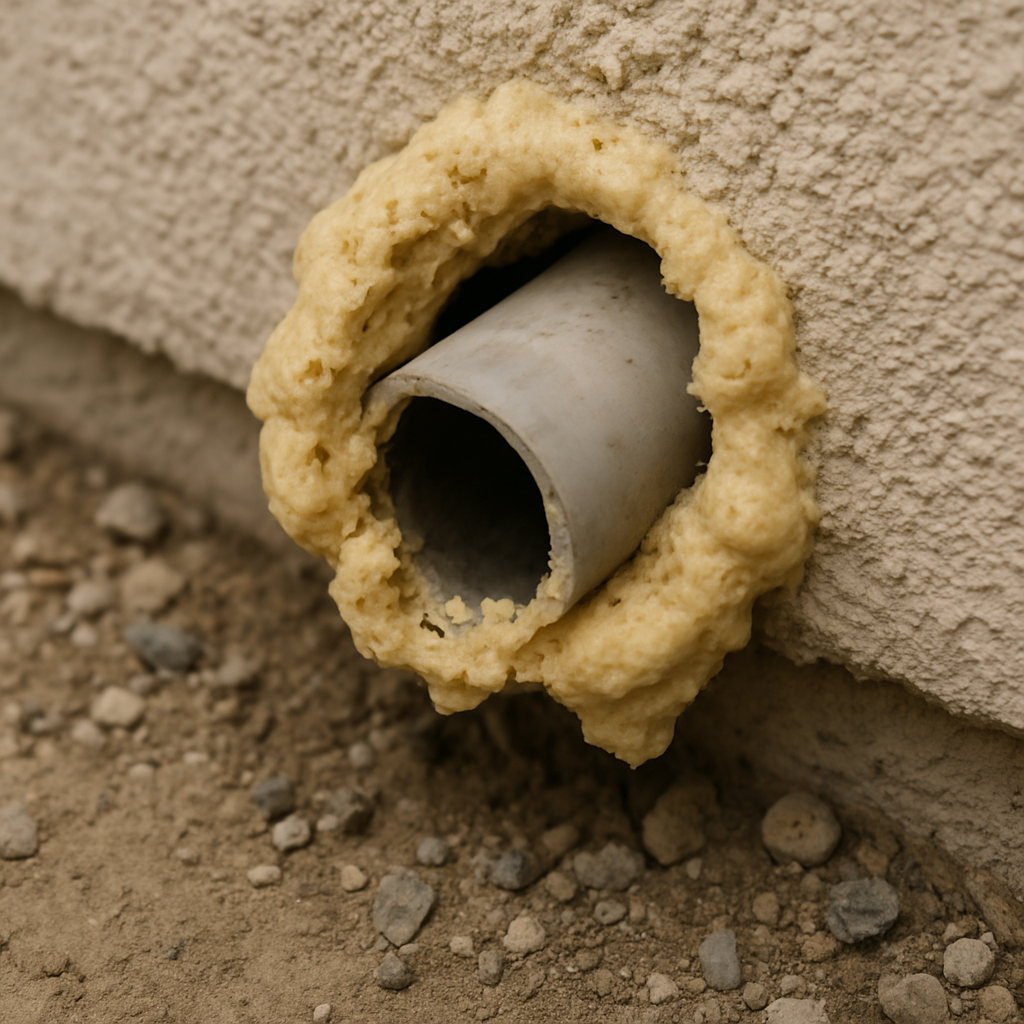
A homeowner spends a full Saturday sealing visible gaps around the foundation. Pipe penetrations under the sink, the dryer vent collar, the gap at the base of the door threshold. Good locations. Real entry points. They use expanding foam. It cures rigid. Looks solid. Three weeks later, the scratching is back.
The gnaw-through
Expanding foam, the polyurethane product sold at every hardware store, is not rated as a rodent exclusion material. It cures hard, but it remains chewable. A roof rat applying sustained gnaw pressure works through standard expanding foam in a matter of days. The material fails under the exact mechanical stress the job demands.
Steel wool without a lock
The same pattern applies to standard steel wool used without a caulk lock. Steel wool is the right concept for a gap fill. But steel wool that is not locked in place with a caulk bead compresses under sustained pressure and corrodes when moisture contacts it, especially in the marine layer humidity that rolls through the San Fernando Valley from late spring through summer. Once it corrodes, the barrier function is gone.
The roofline was never touched
The entry points along the roofline, the bird blocks, the deteriorated soffit corners, the fascia gap where a utility line attaches to the exterior wall, were never touched. Not because the homeowner was not thorough. Because they could not see them from the ground, and reaching them safely was not realistic.
We credit what you got right, and show you where the limit is
Every entry point a homeowner correctly identified and sealed gets noted in our assessment, because that information shows where pressure shifted.
When our crew conducts a post-DIY assessment in Los Angeles, the visible gaps a homeowner sealed are part of the data. A sealed pipe penetration that held tells us the rodent activity did not stop because something else is open. A foam-filled gap that was gnawed through tells us exactly what the material failure mode was, and which opening is now the primary access point.
A prior DIY attempt is a partial audit that narrows the scope of what is left to find. We work from there.
What a self-performed seal cannot provide: a full entry point audit, a systematic inspection of the entire building envelope, interior and exterior, at all elevations. That includes the roofline, the soffit line, every point where a tree branch or utility line approaches the structure, and every gap in the foundation and crawl space. Visible entry points are a subset of that. The full picture requires getting above them.
How professional exclusion covers the zones DIY cannot reach
Gnaw-resistant materials matched to each gap type, applied at the elevation where the rodents actually enter.
Hardware cloth
Galvanized steel mesh is cut and fitted over foundation vent openings. It does not compress and it does not corrode. That is two failure modes eliminated.
Xcluder fabric
A stainless steel and poly blend fills irregular pipe penetrations where rigid mesh will not conform. It is rated for sustained rodent pressure in a way that hardware store foam is not.
Copper mesh
With a caulk lock, goes into smaller gaps, the kind that look sealed at a glance but are not.
At the roofline, crew members access bird blocks and soffit corners with ladder equipment, confirm entry path evidence visually, and seal with materials appropriate to each gap type. One open bird block on a Spanish tile roof can serve an entire active attic population. Sealing the foundation while that block remains open redirects activity, it does not reduce it.
The three variables that decide the outcome
Most self-performed jobs address one of the three well. The full job requires all three.
Determines whether the seal holds under gnaw pressure. Standard foam and uncaulked steel wool fail under sustained mechanical stress. Galvanized mesh, Xcluder fabric, and copper mesh hold.
Determines which entry points are reachable. Ground-level work covers foundation, threshold, and lower-wall openings. Roofline and soffit work requires ladder access and knowledge of where roof rats actually travel.
The difference between sealing what you can see and knowing every opening on the property. A full audit connects active population evidence, gnaw marks, grease trails, and dropping locations to specific entry points at every elevation.
Frequently asked questions
Is expanding foam enough to keep rats out?
No. Expanding foam is not rated as a rodent exclusion material. It cures hard but remains chewable. A roof rat applying sustained gnaw pressure works through it in a matter of days. Gnaw-resistant materials like galvanized hardware cloth, Xcluder fabric, and copper mesh hold where foam fails.
Why do rats come back after I seal the foundation?
In Los Angeles the dominant rodent is the roof rat, which enters from above. The entry points along the roofline, the bird blocks, deteriorated soffit corners, and fascia gaps are usually never touched during DIY work. One open bird block can serve an entire active attic population, so sealing the foundation redirects activity rather than reducing it.
Was my DIY effort a waste if it did not fully work?
Not at all. A prior DIY attempt is a partial audit that narrows the scope of what is left to find. Every entry point you correctly identified and sealed gets noted in our assessment. A sealed gap that held tells us activity continues because something else is open. We work from there.
What does a full entry point audit include?
A systematic inspection of the entire building envelope, interior and exterior, at all elevations. That includes the roofline, the soffit line, every point where a tree branch or utility line approaches the structure, and every gap in the foundation and crawl space.
Professional rodent proofing across Los Angeles after DIY attempts
We regularly assess properties where prior sealing work is in place and continue the audit from where it stopped. The communities we serve sit directly in the range of the highest roof rat pressure in LA.
- Tarzana
- Encino
- Woodland Hills
- Reseda
- Canoga Park
- Sherman Oaks
- Van Nuys
Know where your DIY work ended, then let us cover the rest.
You did the right thing by sealing. Now let us map what is still open, at the roofline, at the soffit, at every elevation that was not reachable from the ground.
Rodent R Us · 5336 Mecca Ave, Tarzana, CA 91356 · in**@*******us.com