
Hardware cloth, Xcluder, and concrete. The right material for the right gap.
Material choice is not an afterthought. It is the entire outcome.
4
Core sealing materials
15+
Field members available
100%
Documented openings
0
Estimates before inspection
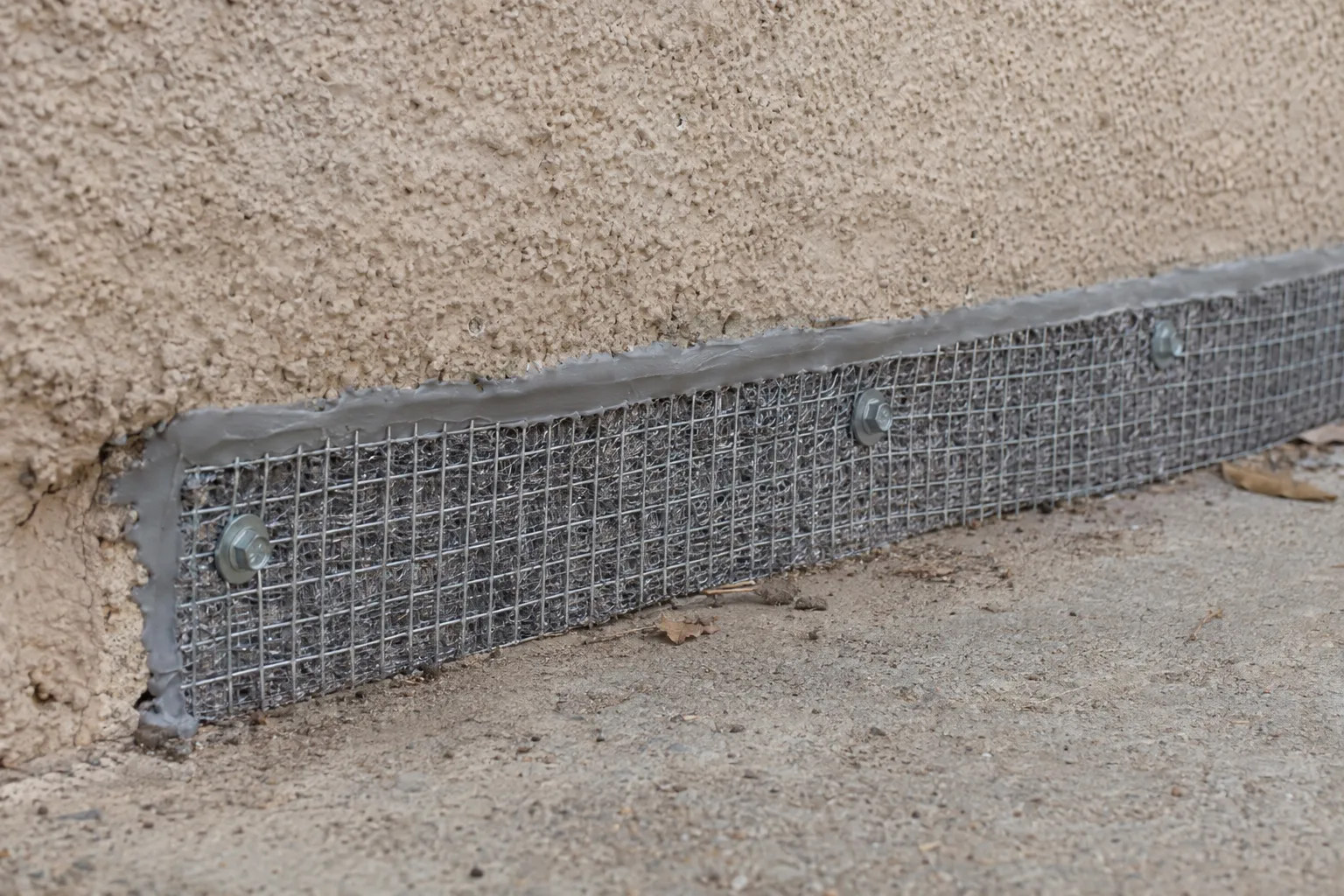
Rodent-proof sealing works when the right material meets the right gap. Steel wool compresses under sustained pressure. Expanding foam cures rigid but stays chewable. A gap sealed with the wrong product is not a sealed gap, it is a sealed gap with a countdown on it.
Rodent-proof sealing, the practice of closing every confirmed entry point using materials rated for sustained gnaw pressure, is the core of what exclusion work does. Not every opening takes the same material. A foundation vent needs something different than a pipe penetration. A roofline gap needs something different than a block wall void.
Hardware cloth (heavy-gauge galvanized steel mesh), Xcluder fabric (a commercial-grade fill combining stainless steel and poly fibers), copper mesh (a non-corrosive fill rated for wet and exterior zones), and concrete patching are each applied based on what the gap requires, not based on what is easiest to carry in a truck.
Los Angeles homes from the 1950s through the 1970s were built with gaps that were never meant to stay open this long.
Working from our Tarzana base, we encounter the same failure points on the same construction era, week after week across the western San Fernando Valley.
The original vent screens on a 1965 Reseda ranch house were not designed to last sixty years. The mesh corrodes. The frame pulls loose from the stem wall. The opening that results is the right size for a roof rat to push through without slowing down.
Any point where plumbing, electrical conduit, or HVAC lines pass through a wall or floor was commonly left with a clearance gap during original construction. That gap gets larger as wood frames dry and shift. A quarter-inch gap can measure three-quarters of an inch after a few decades of Southern California seismic activity.
The bird block gap, the open space beneath clay tile where the tile edge meets the fascia, is a structural feature of Spanish Colonial and Mission-style architecture, not a defect. On a new installation it is tight. On a home where the fascia has warped from sun exposure, it is open access into the attic.
None of these are visible from the driveway. That is the problem with a visible-only self-inspection.
Every gap on a property gets evaluated individually before any material is selected. Surface type, moisture exposure, gap size, location relative to rodent travel paths, and access difficulty all factor into which product goes in.
Applied over foundation vent openings, crawl space access points, and any larger structural gap where a rigid barrier can be mechanically fastened. Galvanized. Heavy gauge. Cut on-site to fit.
Used for pipe penetrations, irregular voids, and any opening where rigid mesh cannot conform to the shape of the gap. Stainless steel and poly fiber construction, rated for sustained gnaw pressure.
Installed in exterior gaps with moisture exposure. Non-corrosive. Maintains barrier integrity in wet-zone conditions where galvanized steel would degrade.
Applied to foundation cracks, block wall voids, and stem wall gaps. Hydraulic cement or mortar depending on the surface. Permanent fill for structural openings.
Used wherever mesh is installed over a vent or opening. Mesh is screwed or stapled to the frame, not friction-fit. A friction-fit screen is not a sealed screen.
No single product is applied uniformly across all gap types. Each material above is used only where the opening, surface, and exposure conditions call for it.
We walk into attics where a homeowner has done everything right in theory and everything wrong in materials. Steel wool packed into a pipe gap. Expanding foam sprayed along the fascia line. Both of those products belong in a different application. Neither belongs in a rodent exclusion job.
Rodent incisors are harder than the materials most hardware store products are rated for, and a rat will work the same spot for hours across consecutive nights. Standard expanding foam is a thermal and air-sealing product. It has no gnaw rating at all, and we routinely find foam seals defeated within days of installation, not because the homeowner installed it incorrectly, but because the product was never made for this.
Steel wool follows the same pattern, just slower. It compresses under sustained pressure. Then moisture gets into the compressed fibers and corrosion starts. Within a few months in an exterior or semi-exterior location, the barrier is gone. The Los Angeles climate accelerates both processes: UV exposure breaks down the polymer in foam faster than it would in a cooler climate, and coastal humidity speeds the corrosion cycle on untreated steel wool.
The second problem is access. A homeowner can seal every visible gap at ground level and still miss every point where rodents are actually entering. In Los Angeles, roof rats, Rattus rattus, the aerial-traveling species dominant in this market, enter from the roofline. They follow utility lines and citrus branches to the eave. Ground-level sealing does not address the elevation where this animal operates.
That gap between a thorough self-sealing effort and a complete exclusion job is where the scratching comes back.
Assessment, documentation, and closure happen in that order, never skipped, never compressed.
The crew begins with a full-perimeter inspection before any material is placed. Every foundation vent is checked for screen integrity and frame condition. Every pipe penetration is probed for clearance. Every point where a utility line, conduit, or plumbing run crosses through a wall, floor, or ceiling is examined.
At the roofline, the crew works the fascia line, soffit, and every point where tree canopy or utility lines approach the structure. Bird block gaps under tile are checked individually. Fresh gnaw marks indicate an active probing location. Those get priority.
Each confirmed or probable entry point is documented by location before sealing begins.
Material selection follows the assessment. Hardware cloth panels are cut and mechanically fastened. Xcluder is packed firmly into pipe gaps without compression voids at the edges. Copper mesh is pressed into wet-zone openings and secured. Concrete patching is mixed to specification and applied to structural gaps with the surface prepared for adhesion.
Rodent-proof sealing is not complete until every documented opening has a confirmed material in place. The checklist runs against the assessment record.
After sealing is complete, the crew conducts a final walkthrough of all sealed points. Each installation is physically checked. Mesh panels are tested for fastener integrity, fill materials are checked for edge gaps, and concrete patches are checked for full coverage.
The homeowner receives written documentation of every sealed entry point by location and material. That record serves as the baseline for any future retainer inspection or re-check.
Both belong in a different application. Steel wool compresses under sustained pressure and corrodes once moisture reaches the fibers. Expanding foam cures rigid but stays chewable and carries no gnaw rating. We use materials rated for sustained gnaw pressure, matched to each specific opening.
No. Every gap is evaluated individually. Foundation vents get hardware cloth, pipe penetrations get Xcluder fabric, wet-zone exterior gaps get copper mesh, and structural openings get concrete patching. Surface type, moisture exposure, gap size, and access all factor into the choice.
In Los Angeles, roof rats enter from the roofline, following utility lines and citrus branches to the eave. Ground-level sealing does not address the elevation where they operate. A thorough self-effort can still miss every point where rodents are actually entering.
Yes. Each confirmed entry point is documented by location before sealing. After the work, you receive a written record of every sealed opening and the material used to close it. That record serves as the baseline for any future retainer inspection.
No. No estimate before inspection, and no material installed before documentation. Rodent-proof sealing starts with a written assessment of every opening on your property.
Rodent R Us serves Los Angeles from its Tarzana base at 5336 Mecca Ave. Call to confirm availability at your property.
Rodent-proof sealing starts with a written assessment of every opening on your property. With 15 or more field members available, appointments are not held to a single technician's schedule.
Rodent R Us · 5336 Mecca Ave, Tarzana, CA 91356 · in**@*******us.com