

Why Los Angeles Has a Roof Rat Problem, And What It Means for Your Home
How Rattus rattus uses LA's trees and rooflines to enter your home.
How Rattus rattus Uses LA's Trees and Rooflines to Enter Your Home
The species most LA homeowners are dealing with enters from above, not the ground.
Los Angeles Has a Specific Rat Problem, Not a Generic One
The rat living in your attic right now is not the rat most pest control guides describe.
Rattus rattus, the roof rat, also called the black rat, is the dominant rodent species across Los Angeles. It does not burrow. It does not push through foundation vents or dig under concrete. It climbs. It runs along telephone lines, travels through tree canopies, and drops from overhanging branches directly onto your roofline. If you have been following general rodent advice, sealing ground-level entry points, checking foundation vents, setting snap traps at floor level, you have been solving a different animal's problem.
That gap between national pest control guidance and what actually happens on a Los Angeles property is why infestations here tend to return. The entry points are eight feet off the ground. The travel paths run through your neighbor's citrus tree. The species profile is specifically suited to Southern California's urban canopy, its warm climate, and its architectural stock. Understanding what this animal actually does is the first step toward a fix that holds.
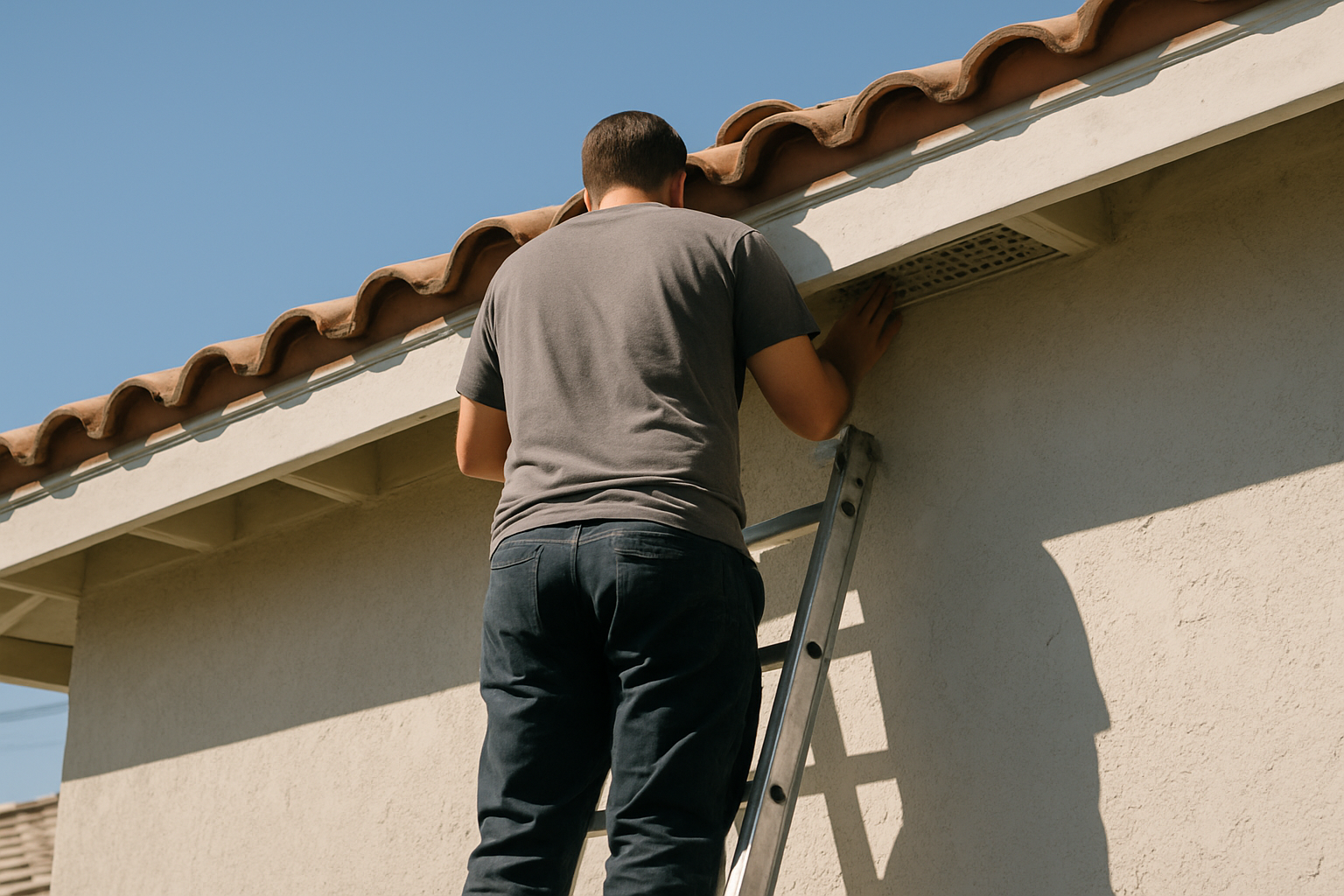
◆ A Roof-Up Approach
The entry points are at the roofline. Ground-level measures alone will not hold in LA.
Why the Los Angeles Environment Produces This Specific Pressure
Los Angeles is, without qualification, the roof rat capital of the United States.
That is not hyperbole. It is a function of climate, vegetation, and urban density combining in a way that almost no other American city replicates.
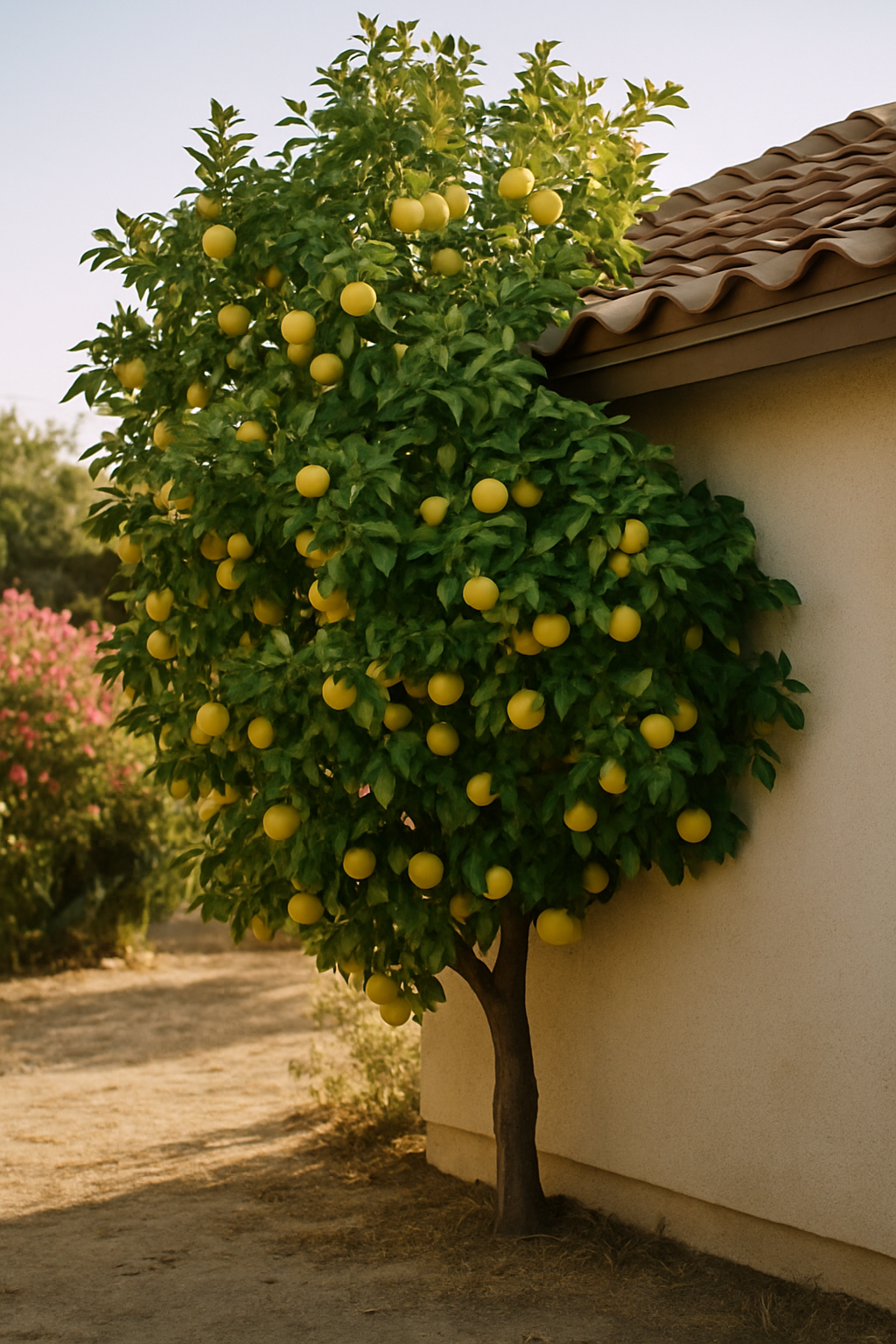
Start with the urban tree canopy. Los Angeles neighborhoods are planted with citrus, oranges, lemons, grapefruits, as well as avocado, fig, and palm trees. These are not decorative features to a roof rat. They are a food source and a highway. Rattus rattus, the black rat, an aerial traveler adapted to warm urban environments, feeds on ripening fruit and uses branch networks to move between properties without touching the ground. A mature lemon tree in a Tarzana backyard that overhangs a fence line becomes a direct bridge between a neighbor's lot and your roofline.
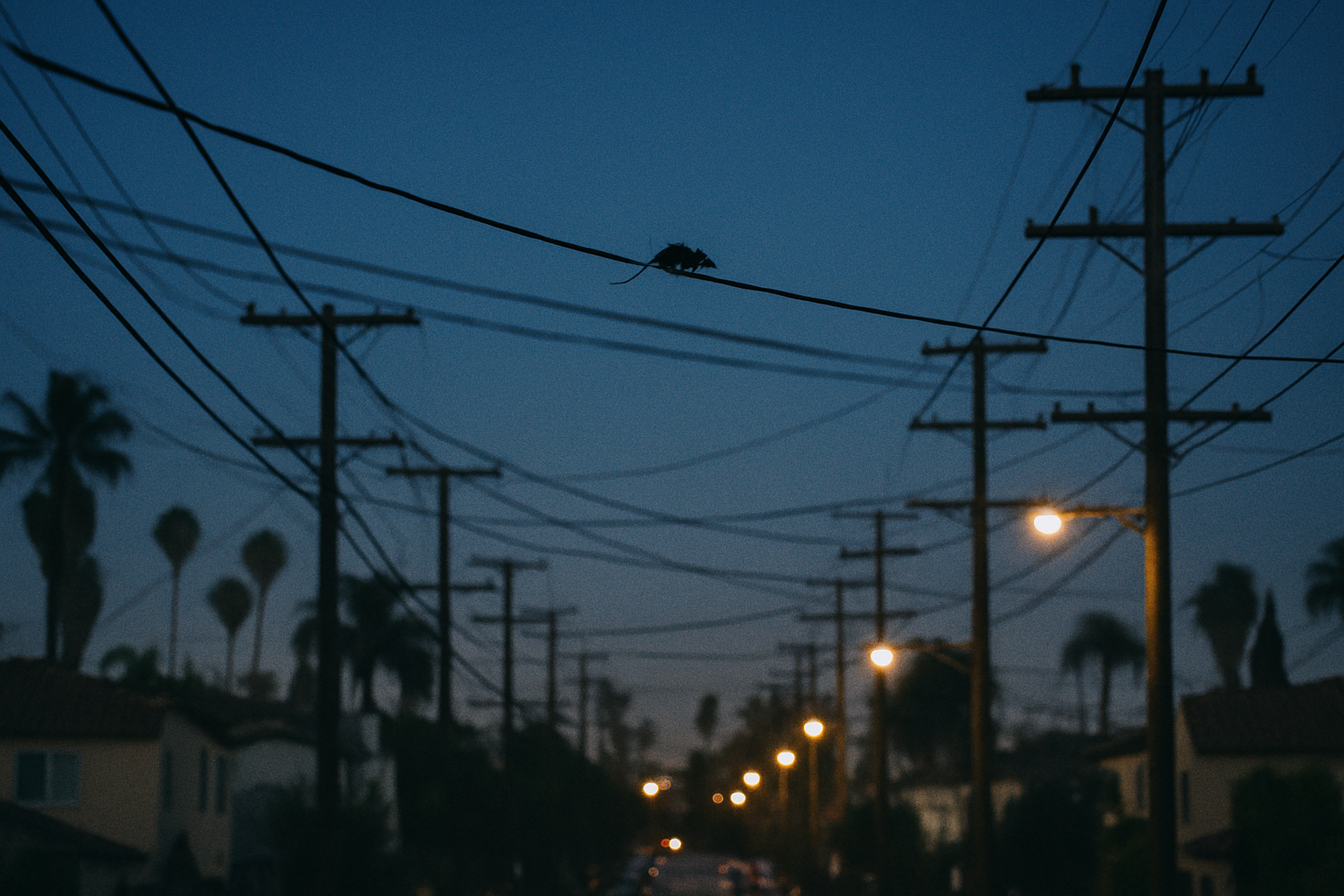
Then there is the infrastructure. Power lines, cable lines, and telephone lines run at roofline height across every residential block in the San Fernando Valley. Roof rats travel these lines routinely. The utility line bridge, the attachment point where a line meets your home's exterior, is one of the most commonly exploited entry zones in LA, and it rarely appears in national rodent guides.
Add the climate. Los Angeles sustains active rodent populations every month of the year. There is no winter die-off. No cold-weather season that interrupts the pressure. The species stays active, stays mobile, and keeps probing new entry points 365 days a year.
This combination, aerial travel, abundant food sources, and no seasonal interruption, produces a rodent pressure profile that requires a roof-up inspection strategy. Ground-level measures alone will not address it.
15+
Field technicians
100%
Direct employees
Written
Report every job
Same-week
Scheduling
How Roof Rats Actually Enter Los Angeles Homes
Entry happens at the roofline, and LA's housing stock is built to make that easy.
Spanish Tile Bird Blocks
The Spanish tile bird block is the open gap that sits beneath clay roof tiles where the tile edge meets the fascia at the roofline. It is a standard feature of Mission-style and Spanish Colonial Revival construction, the dominant residential architecture across Tarzana, Encino, Woodland Hills, Calabasas, and the western San Fernando Valley.
This gap exists for ventilation. In new construction, it is screened. In older construction, particularly homes built before 1980, that screening has frequently deteriorated, pulled away from the fascia, or was never installed correctly. A roof rat needs an opening of approximately half an inch to enter. The average unscreened bird block provides far more than that.
Here is what most homeowners do not realize about these gaps: because the opening faces downward at the roofline, it is not visible from the ground. A homeowner looking up at a Spanish tile roof cannot see whether the bird blocks are open. Neither can a general home inspector walking a property with binoculars. Assessment requires physically accessing the roofline, which is one reason this entry zone goes unaddressed for years on properties with active infestations.
Soffit Deterioration
The soffit, the enclosed underside of a roof overhang, is the second most common entry point on Los Angeles homes. In the San Fernando Valley's housing stock from the 1950s through 1970s, soffit panels were typically made of wood or low-grade composite material. Decades of sun exposure, temperature cycling, and occasional moisture from marine layer events have caused these panels to warp, crack, and pull away from the fascia boards they attach to.
Even a quarter-inch gap where a soffit panel lifts away from its mounting board is enough. Roof rats can gnaw an opening wider within hours once they identify a gap worth exploiting. Rattus rattus is documented to have spatial memory of a property's exterior. A rat that found a gap last season will return to test the same location the following year.
Fascia Board Rot
Fascia boards run horizontally along the roofline and serve as the backing surface for gutters and the attachment point for soffits. In older Valley homes, fascia rot, caused by water intrusion behind deteriorated gutters or repeated wetting from irrigation overspray, creates gaps at the junction of the fascia and the structural rafter tail. These gaps are interior-facing and largely invisible from the exterior.
A roof rat exploring a roofline at night will probe every seam, every material junction, every point where two surfaces meet imperfectly. Rotted fascia often produces a soft spot that gnawing converts into an opening within a single evening. By the time a homeowner hears activity in the attic, the entry point may already be the size of a tennis ball.
Utility Line Attachments
The point where a power, cable, or telephone line attaches to a structure, the utility line bridge, is a standard travel termination for roof rats. The rat walks the line from a utility pole or from a tree it has already climbed, reaches the exterior of the house, and immediately begins probing the structure at that elevation. The attachment bracket often penetrates the exterior sheathing, and any gap between the bracket and the penetration is a candidate for entry.
This entry zone matters for a specific reason: it is essentially impossible to address with any ground-level exclusion method. The rat arrives at the structure from above and never touches the soil.
What This Looks Like on a Valley Property
Three situations play out repeatedly across Tarzana, Encino, and Woodland Hills, all with the same underlying cause.
The Mature Citrus Tree Adjacent to the Roofline
A homeowner in Tarzana has a large orange tree in the backyard. Branches overhang the roof by two or three feet. The property has never had a confirmed rodent problem. In late summer, when the fruit ripens, roof rat activity along the branches increases sharply. Within a few weeks, a rat using the branches as a travel path finds the soffit gap at the back roofline corner. By October, there are confirmed sounds in the attic above the master bedroom. The homeowner calls. The entry point is identified at the soffit junction, eight feet up on the rear elevation, not visible from the yard.
The 1962 Ranch Home With Original Bird Blocks
A Woodland Hills home built in 1962 still has its original clay tile roof. The bird blocks along the front elevation were screened at installation. Those screens, galvanized hardware cloth stapled directly to the wood nailer beneath the tiles, have corroded and separated from the nailer at three points along the south-facing elevation. The gaps are less than an inch. An inspection using a camera wand at roofline height shows fresh gnaw marks at each gap edge and active grease trails on the tile surface above them. The infestation has been active for at least one full season without the homeowner knowing.
Post-Fire Displacement and New Entry Probing
Following the 2025 Palisades fire, neighborhoods west and north of Tarzana saw documented increases in roof rat complaints. Properties that had been rodent-free were receiving new pressure from displaced populations moving through the canyon-adjacent corridors. A homeowner near the Topanga Canyon wildlife corridor, the undeveloped open space bordering the western San Fernando Valley that provides continuous habitat between wild rodent populations and residential neighborhoods in Tarzana and West Hills, found active entry at a utility attachment point they had never needed to address before. The population pressure had changed. The structure had not.
What Our Crew Sees on These Properties Every Week
The same property features appear on every inspection in the Valley, and they are almost always at the roofline.
When our crew arrives at a property in Tarzana or Encino, the first step is to look up. Specifically, we look at where the roofline meets the structure, every soffit seam, every fascia board junction, every tile edge, every utility attachment point. That is where Rattus rattus operates. That is where the evidence is.
What we find consistently on homes in this part of Los Angeles: bird blocks that were screened at construction and have not been checked since. Fascia boards with soft spots behind otherwise-normal-looking surfaces. Utility line attachments with quarter-inch gaps that have been there for two decades without anyone flagging them. Citrus trees that have grown into the roofline over fifteen years and now provide a direct branch bridge to an unscreened attic vent.
None of these are unusual. All of them are specific to this housing stock, this species, and this city. The local knowledge gap is real, it is why we see properties where previous treatments produced no change in activity. The entry points were never identified because the inspection never looked at the right elevation.
Rodent R Us, Tarzana, CA
When a Property Assessment Makes Sense for Your Home
An inspection becomes the right next move when you have evidence but no confirmed source.
You do not need to wait for a confirmed sighting. Rattus rattus is nocturnal and rarely seen during the day. It leaves indicators that a trained inspection can identify and map.
Sounds in the ceiling at night, particularly from a single zone above a room, are consistent with roof rat movement along a travel path between an entry point and a nesting area. Droppings in the attic confirm active nesting. A citrus or avocado tree with branches within several feet of your roofline is part of the inspection. If your home was built before 1980 and the bird blocks have never been assessed, scheduling that work before an infestation establishes is more efficient than addressing one after.
An inspection performed before the fall temperature shift, when outdoor rodent populations begin probing structures for warm shelter, gives you a documented picture of your property's current vulnerability. That picture is more useful than a DIY walkthrough because it covers the elevation where this species actually operates and produces a written entry point map you can act on.
Based in Tarzana, Serving the Valley
Rodent R Us is based in Tarzana and serves roof rat inspections and exclusion work across Los Angeles.
We work across Tarzana, Encino, Woodland Hills, Calabasas, West Hills, Reseda, Canoga Park, Sherman Oaks, and surrounding San Fernando Valley communities. Our crew dispatches from 5336 Mecca Ave, Tarzana, inside the neighborhoods described throughout this guide.
Read the Property, Then Call
This guide gives you the species knowledge. A property assessment gives you the entry point map.
Understanding how Rattus rattus moves through Los Angeles is the foundation. Knowing your specific property's vulnerability requires eyes at roofline height and a written record of what is found there.
Call Rodent R Us at (323) 805-0173 or email in**@*******us.com to schedule a roof rat inspection. We serve residential and commercial properties across the Los Angeles metro, dispatching from Tarzana. The assessment is the starting point, from there, every entry point gets documented before any sealing begins.
Ready to Get Started?
Contact us today for a free consultation.